
Bottle labelling guide
Front and back label positioning guide.
Plan accurate two-sided label application for flat, oval, square and shaped bottles.
Front/back labelling is about controlling presentation.
A front and back labeller must present each bottle consistently to two label heads. This is more demanding on oval, flat and square containers because the label panels need to line up with the machine rather than rotating freely.
Product guides, side belts and spacing controls can be required to keep the container steady.
Confirm label panel size and tolerance.
The available label panel may be smaller than the visible face of the bottle because of shoulders, radiused edges, recesses or moulding. Edge clearance should be measured before labels are printed.
Artwork should allow realistic tolerance. Very tight edge alignment can make the machine specification more demanding.
Check front/back matching.
The front and back labels may be different sizes, shapes or roll directions. Those details must be known before the machine is specified because they affect label head set-up and changeover.
Checklist before you enquire
- Front label size and back label size
- Panel dimensions and edge clearance
- Bottle shape, taper and shoulder design
- Required label alignment tolerance
- Whether the container is soft or rigid
- Line speed and product spacing
- Label roll direction for both labels
- Samples from each bottle size
FAQ
Common questions.
Can both labels be applied in one pass?
A twin-side labeller can often apply front and back labels in one conveyor pass.
Do front and back labels need separate rolls?
Often yes, especially when artwork or label sizes differ.
Can round bottles be front/back labelled?
Yes, but orientation and label spacing must be checked.
Why are samples important?
Samples show how the bottle presents under guides and side belts.
Next steps
Related bottle labelling pages.
Front and back label placement record.
Two-sided label placement should be checked using the actual bottle panel, label sizes and finished label material. Record which panel is the datum, the front label height, the rear label height and any visual alignment requirement between them.
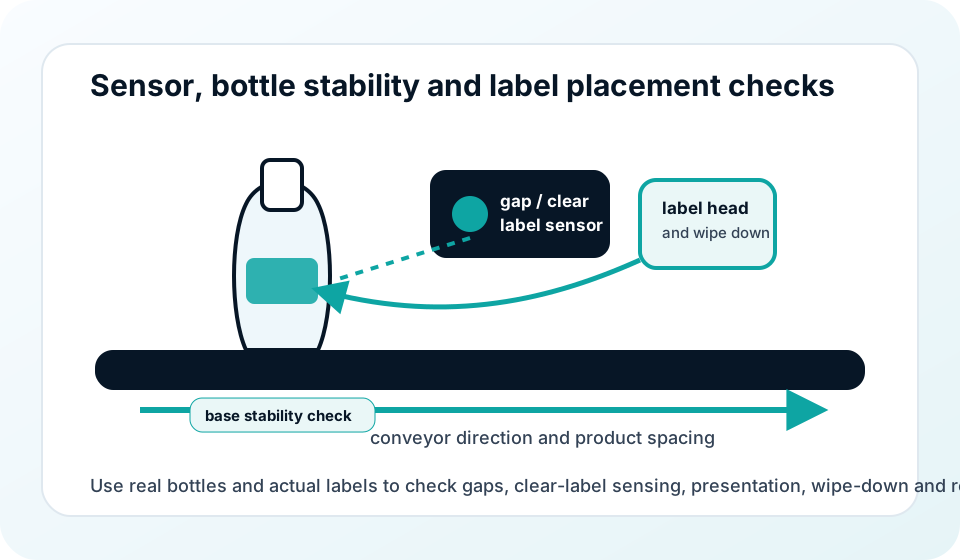
Information gain for a faster answer
- Container: diameter or panel width, height, material, base shape, taper, shoulder shape and whether the container is empty or filled during labelling.
- Label: width, length, gap, roll direction, core diameter, liner type, transparent/opaque material and whether overprinting is required.
- Line: target output, operator involvement, conveyor direction, available space, coding position and any upstream filling or capping equipment.
| Question | Engineering reason | Next action |
|---|---|---|
| Is the container round, flat, oval, square or tapered? | Shape determines whether rotation, side guiding or top/bottom transfer is the main control point. | Compare machines |
| Is the label clear, metallic, small, wraparound or front/back? | Label material and gap determine sensing and setup checks. | Review sensing |
| Has the label roll already been printed? | Roll direction and artwork orientation may affect machine compatibility. | Check roll direction |
| Is presentation critical? | Premium labels, front/back matching and clear labels should be checked with samples before final specification. | Prepare samples |
For round bottles, start with wraparound labelling. For flat, oval and square containers, review front and back labelling. When in doubt, send photos and dimensions and Lancing can identify the better machine route.
Ready to have a labelling project checked?
Send bottle samples, label details or photos and the production target so Lancing can narrow the route.