
Bottle labelling guide
Round bottle label placement guide.
Plan label length, start position and wraparound coverage before selecting a round bottle labeller.
Work out whether the label is wraparound or panel style.
A wraparound label follows the curve of the bottle. A panel label may sit on the front only, or as separate front and back labels. The machine route and label timing depend on this decision.
For full wrap labels, label length and bottle diameter need to be checked so the label does not overlap unexpectedly or finish in the wrong position.
Consider start and end position.
The start position can matter when artwork has a barcode, ingredients panel or front-facing brand panel. Round bottles without orientation features are normally easier to label than bottles that need a precise start position relative to a mould mark or closure.
If the label wraps close to a shoulder, taper or rib, testing is recommended.
Check label sensing and wipe-down.
Label placement accuracy depends on label sensing, product rotation and wipe-down pressure. Clear labels or unusual backing paper may require different sensors and testing before production.
Checklist before you enquire
- Bottle diameter and circumference
- Label length and height
- Label start position requirement
- Full wrap, partial wrap or front/back spacing
- Bottle taper, ribs, seams or shoulders
- Label material and backing paper
- Target tolerance and output speed
- Filled and empty sample behaviour
FAQ
Common questions.
Can round bottles have separate front and back labels?
Yes, but label spacing and application timing must be checked.
Can a label wrap fully around the bottle?
Often yes, if label length and bottle diameter are suitable.
Why do labels drift on round bottles?
Drift can come from rotation, taper, label feed, backing paper or wipe-down issues.
Can clear labels be placed accurately?
They can often be applied with suitable sensing and testing.
Next steps
Related bottle labelling pages.
Selector checks to confirm before choosing the machine route.
Bottle shape, label material, desired presentation and line integration all affect the correct machine route. Use the checklist below to move from a general labeller enquiry to a machine recommendation that can be sample tested.
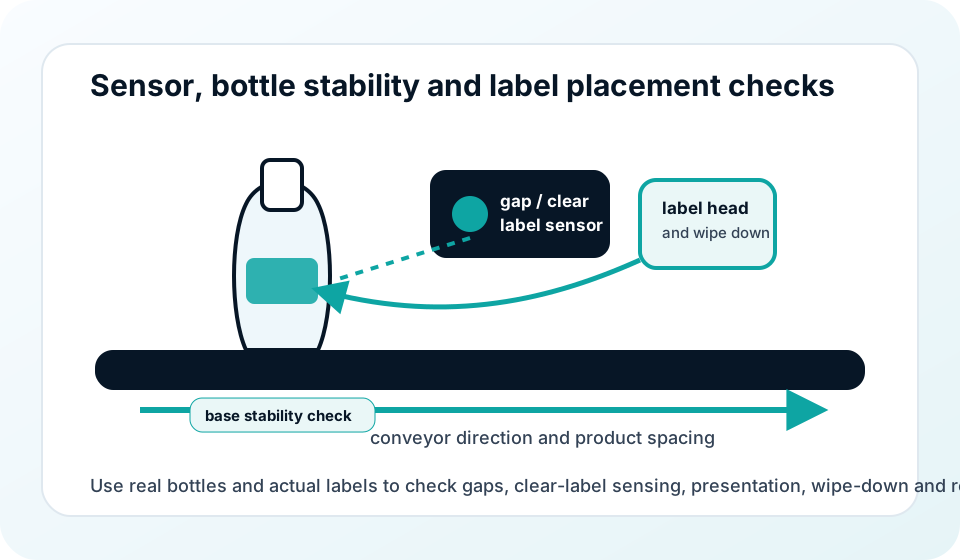
Information gain for a faster answer
- Container: diameter or panel width, height, material, base shape, taper, shoulder shape and whether the container is empty or filled during labelling.
- Label: width, length, gap, roll direction, core diameter, liner type, transparent/opaque material and whether overprinting is required.
- Line: target output, operator involvement, conveyor direction, available space, coding position and any upstream filling or capping equipment.
| Question | Engineering reason | Next action |
|---|---|---|
| Is the container round, flat, oval, square or tapered? | Shape determines whether rotation, side guiding or top/bottom transfer is the main control point. | Compare machines |
| Is the label clear, metallic, small, wraparound or front/back? | Label material and gap determine sensing and setup checks. | Review sensing |
| Has the label roll already been printed? | Roll direction and artwork orientation may affect machine compatibility. | Check roll direction |
| Is presentation critical? | Premium labels, front/back matching and clear labels should be checked with samples before final specification. | Prepare samples |
For round bottles, start with wraparound labelling. For flat, oval and square containers, review front and back labelling. When in doubt, send photos and dimensions and Lancing can identify the better machine route.
Ready to have a labelling project checked?
Send bottle samples, label details or photos and the production target so Lancing can narrow the route.