Extended-content label applications

Can a bottle labeller apply booklet or multi-layer labels?

Extra printed information changes the label construction, not just the artwork. Use the finished booklet and its production reel to assess the complete application route.

Can an existing bottle labeller handle a booklet label?

Some booklet and multi-layer labels can be machine-applied, but compatibility must be demonstrated on the actual construction and bottle. Thickness, stiffness, opening-tab position, liner release, sensor response and the wipe-down path all need review. A successful trial with an ordinary single-layer label does not approve the same machine for a booklet.

This is application-selection guidance, not a claim that every Lancing model has a booklet-label option. Agree the required machine configuration and sample-trial outcome before ordering either the equipment or a production label run.

What is the difference between booklet and multi-layer labels?

Expanded or extended content label (ECL) describes a label with additional information area. A booklet may incorporate a folded or bound insert; a multi-layer label may provide liftable layers instead. The construction determines how the label behaves on the reel and at the bottle. CCL: expanded content label constructions and CCL: multi-layer labels describe these separate formats.

Construction distinctions to confirm with the label converter
ConstructionApplication questionFinished-pack question
Booklet on a pressure-sensitive baseWhere is the thickest section, and does the assembly separate and transfer as one label?Does the booklet stay attached and open without pulling the base from the bottle?
Multi-layer peel-and-reseal labelAre the layers stable through the web path, sensor and pressure elements?Can the intended layer be opened and reclosed without damaging the base or obscuring information?
Unsupported-film roll-fed ECLDoes the construction belong to a different roll-fed labelling process?Are its opening, closure and wrap arrangement suitable for the actual pack?

Do not confuse a pressure-sensitive reel on a liner with every product described as roll-fed. QAL: unsupported-film roll-fed extended content labels gives an example of an unsupported-film ECL; that is not automatic evidence of compatibility with the lined self-adhesive machine range on this site.

What must a booklet-label application trial prove?

  1. Reel fit and condition. Record core, outside diameter, web width, winding direction, label pitch and the position of the booklet on its base. Check that the reel remains stable through the approved unwind path.
  2. Detection. Present the complete printed construction to the proposed sensor. Layers, air spaces, coatings and local thickness changes may affect detection differently from a single-layer sample.
  3. Release and transfer. Watch the complete assembly at the peel edge. Identify any layer separating too early, snagging or following the liner.
  4. Pressure path. Establish where the wrap belt, roller or wipe touches the booklet and opening tab. Test that pressure seats the base without opening or damaging the information layers.
  5. Container geometry. Test the intended panel or radius with the normal fill and closure. Include the edges of a booklet, not only its centre, in the placement checks.
  6. Downstream handling. Check guides, inspection, accumulation and packing for contact with the thicker label or accessible tab.

The basic self-adhesive process separates a label from its liner and takes up the backing, as described by HERMA: label web, dispensing and liner rewind. The checks above are a proposed acceptance framework for the complete assembly; they do not set a universal thickness limit or operating speed.

Use the sensor guide for detection principles and the FAT checklist to record agreed results.

Keep the information accessible after labelling

Mark the opening edge and the permitted contact areas on the artwork drawing. Define the bottle datum, the booklet’s position relative to a handle or seam, and which printed areas must remain visible while it is closed. Separate the requirement to apply the base correctly from the requirement to open and reclose the layers correctly.

Where a coder or camera is used, define the actual printable panel and its height variation. Test reading on the finished pack rather than approving the flat artwork alone. A detected label is not proof that the booklet contains the right artwork revision or that a variable code is correct.

Booklet space does not, by itself, establish that required product information may legally be moved inside it. The responsible product team must confirm the applicable artwork and accessibility obligations for the product and market.

Questions to resolve before machine selection

Will a booklet run at the same speed as an ordinary label?

Do not assume equal speed. The complete label assembly, bottle handling, detection, transfer and inspection determine the acceptable operating window. Specify the required good-pack output, then demonstrate it with the representative reel and agreed quality checks; do not use a bare applicator rating as the finished-line result.

Can a booklet back label be paired with a conventional front label?

It may be feasible with a suitable application arrangement. Specify the two constructions separately, their relationship to one bottle datum, the required sequence and the finished opening clearance. Independent heads need separate reel and sensor checks; alternating labels on one reel require a different sequence assessment.

Why does the booklet opening-tab position matter to the machine?

An opening tab is intended to be accessible to a user, but can also encounter a wipe, belt, guide or adjacent bottle. Mark its location relative to feed direction and the finished container. Include opening, reclosing and downstream handling in the trial rather than accepting placement alone.

What samples should be supplied for a booklet-label trial?

Supply a production-equivalent reel, the assembled booklet drawing, construction reference, filled and closed bottles, an approved finished sample and a description of the intended handling. Include each significantly different thickness or format, the required production rate and any coding or inspection requirement. Loose flat labels alone cannot represent reel handling.

Continue with front-and-back application routes, wraparound application routes and coding and inspection integration.

Ask for an application review, not a generic compatibility promise

Send the finished booklet construction and bottle together. Identify the opening edge, approved pressure areas, intended production rate and acceptance checks so the machine and label specification can be assessed as one project.

Connect the label specification to the machine enquiry

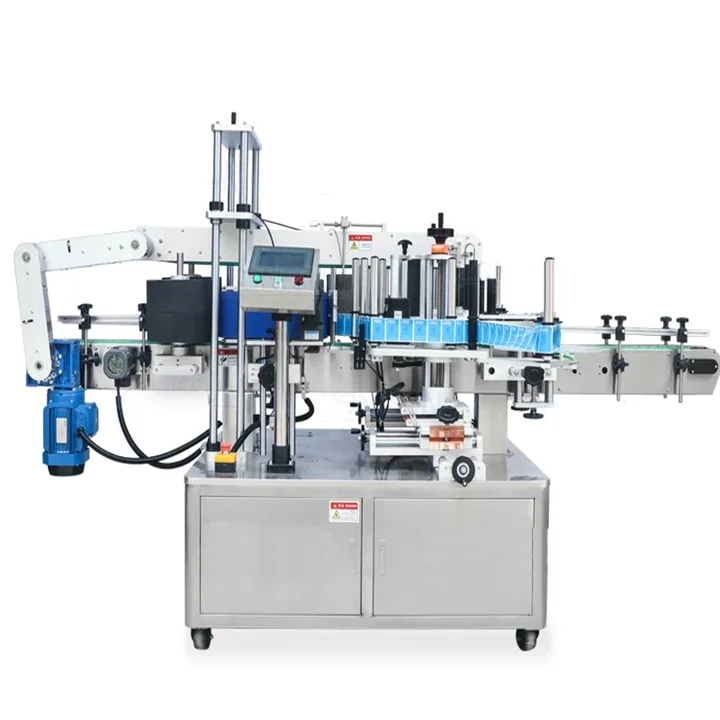
Lancing twin-side bottle labelling machine for application discussions

Illustration from the Lancing website. The actual bottle, finished label construction and approved machine configuration determine suitability.

Application guidance from Lancing. This page distinguishes planning checks from a verified machine specification; results must be confirmed against representative samples.

Technical reference sources