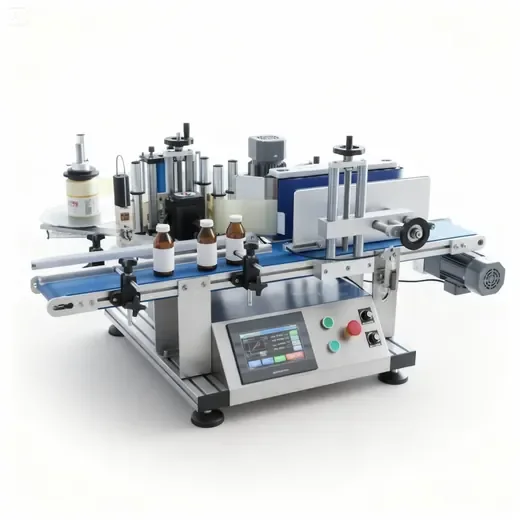
Compact Wraparound Labeller
- Container type
- Round bottles, cans and jars
- Automation
- Compact automatic
- Label types
- Paper or film labels
- Options
- Date/batch coder, sensor upgrades
- Best suited to
- Small lines and bench-to-line upgrades

Compact automatic bottle labelling
Compact automatic wrap labeller for round bottles, cans and jars, suited to smaller production lines and growing manufacturers.
Need a bottle labelling machine specified quickly? Send bottle dimensions, label size and output target.
Request specification adviceCall 01494 623015Overview
A space-saving automatic route for producers moving from bench labelling to repeatable inline operation.
Technical specifications
Final machine dimensions, throughput and options are confirmed against the bottle, label roll, samples and surrounding line equipment.
Integration
Lancing can supply labelling machinery as a standalone unit or integrate it into broader packaging lines with filling, capping, coding, conveyors, inspection and end-of-line handling.
Buyer questions
Send container dimensions, label details and target output. Lancing can normally narrow the correct labelling route from samples, photos and line information.
Yes. Lancing can discuss integration with filling, capping, coding, inspection, conveyors and end-of-line handling.
Samples are strongly recommended because bottle shape, taper, label material, roll direction and handling stability affect the final configuration.
Speak to Lancing
Send samples, label details and speed requirements so the machine can be matched to your container rather than selected from a generic model number.
This added section gives the practical selection detail searchers need without changing the existing machine page above.
The Compact Wraparound Labeller route is most relevant to round bottles, jars, cans and other cylindrical containers where the label is applied as the product rotates. It should be checked against the actual container rather than only a drawing, because presentation, base stability and label surface can change how consistently the label is applied.
Selection normally depends on bottle rotation, wrap pressure, label start point and label wipe-down. Where clear labels are involved, Lancing should review the label material and backing liner so the sensing method is suitable before the machine is ordered.
Changeover planning should include bottle guides, label roll loading, sensor position, label height, job memory or operator settings where fitted, and safe access to the label path for routine cleaning and roll changes.
| Information to send | Why Lancing needs it | Related page |
|---|---|---|
| Container dimensions, photos and sample bottles | Confirms whether the pack can be controlled repeatably through the labelling point. | Sample testing |
| Label width, length, gap, web width and core diameter | Confirms the label roll can feed and present correctly through the label head. | Label roll guide |
| Clear label, metallic label or unusual liner details | Identifies whether specialist sensing or extra setup checks are required. | Clear-label sensing |
| Batch code, date code or barcode position | Shows whether coding needs to be integrated before, during or after label application. | Coding integration |
| Target output and upstream/downstream equipment | Helps match the labeller to the rest of the line and avoid bottlenecks. | Compare labelling routes |
If the container has a flat front panel, oval body or needs separate front and rear labels, review the front and back labelling page before choosing a wraparound route.
Use the buyer guide to compare container shape, automation level and label position before confirming the preferred route.
Actual placement-accuracy trial results, customer case studies and sample test data should only be published when Lancing has verified first-party evidence. In the absence of recorded figures, the safe approach is to define a test pack, label material, target output and acceptance criteria before running samples.
Send product photos, label details, line layout and the output you need.
A compact wraparound labeller can reduce footprint and manual handling, but the application still depends on a stable cylindrical label zone, a workable reel specification and a realistic method for presenting bottles consistently.
Measure circumference at the intended height and record usable straight-wall height, shoulder and heel clearances, seam position and any taper.
List every bottle and label combination rather than quoting only the smallest and largest pack. The difficult format may sit between the extremes.
Include batch length, roll replenishment, operator intervention, upstream accumulation and the time available for routine format changes.
The label size and bottle measurement guide creates a planning record; the changeover checklist identifies the settings and parts that should remain repeatable.
Lancing can review the full format list against the compact and inline alternatives.
A part reel may be suitable when its identity, condition and usable count are known. Compare the remaining labels with the full batch demand before starting. A fresh reel avoids one type of shortage but may leave more part-used stock after frequent format changes.
Record the approved label revision and reel condition with the batch. Distinguish insufficient labels from a machine-speed issue, and include verification at every restart in the schedule. Inventory control remains the operator’s or production system’s responsibility; the machine should not be assumed to identify artwork automatically.
Use the partial-reel planning input and the changeover checks. Send batch sizes and the current reel specification when comparing compact machinery.
Popular searches
A compact footprint does not remove the need for controlled infeed, operator reel access, outfeed space and a practical changeover process. Record how the machine will be loaded now and how upstream automation may be connected later.
Use the conveyor integration guide and changeover checklist before final layout approval.