Batch and consumable planning

How many label rolls will a bottle-labelling batch need?

Plan reel quantities and replenishment using the supplier’s label count and your actual production assumptions. Evaluate each label head separately before combining the line plan.

Calculate label demand before calculating reel changes

Multiply the batch quantity by the number of labels each bottle consumes from the reel being assessed. Deduct any usable labels already loaded, then divide the remaining demand by the usable count on a new reel and round up. Keep front and rear reels separate when independent heads use different labels or reel capacities.

The calculator deliberately uses a supplied label count rather than estimating capacity from outside diameter. Liner, face stock, adhesive, winding and construction change how many labels a reel holds. Booklet labels can make a diameter-only estimate especially unhelpful.

Calculate your batch’s reel requirement

The prefilled values are a worked example, not machine specifications. Enter your own batch, converter reel count and waste allowance. No calculation data is submitted or stored by the website.

Count all bottles planned to receive this label, including any planned trial bottles.

Use 1 for one front-label head. Use 2 only when this one reel supplies two labels to each bottle.

Use the converter’s stated label count, not reel diameter.

Your measured or chosen planning allowance for threading, leader/trailer and expected waste. This is not a Lancing performance figure.

Enter only usable labels remaining on a mounted reel. Enter 0 when preparing a new batch without a loaded reel.

Optional: a trial-supported rate or your scenario, not a promised machine speed.

Optional: include the checks and restart time that apply at your site.

Formulas and worked example

For one label supply, let N be bottles, K labels from this reel per bottle, R labels on a new reel, W unavailable labels per new reel, and S usable labels already loaded.

  • Label demand = N × K.
  • Usable count per new reel = R − W.
  • Remaining demand = the greater of zero and (N × K − S).
  • New reels required = remaining demand ÷ (R − W), rounded up to a whole reel.
  • With a usable reel already loaded, each new reel is an in-batch change. Without one, the first new reel is initial setup, so in-batch changes equal new reels minus one, with a minimum of zero.

Example: 10,000 bottles, one label each, 2,000 supplied labels per reel and 40 unavailable labels per reel leave 1,960 usable labels per reel. Starting without a loaded reel requires six new reels and five changes during the batch, leaving 1,760 usable labels after the batch.

At the example operating rate of 30 bottles/minute, a full usable reel represents about 65.3 minutes of bottle production. Five four-minute changes add 20 minutes to approximately 333.3 minutes of running, giving about 353.3 minutes for running plus those changes only.

Initial setup, breaks, cleaning, inspection holds, material faults, upstream interruptions and other losses are not included. Use the throughput calculator to assess the broader time allowance; avoid counting the same planned stop twice.

How should front-and-back reels be planned?

Reel-planning distinctions
Supply arrangementHow to calculate itScheduling consequence
One wrap label per bottleUse one label per bottle from the wraparound reel.Plan its usable capacity and each change.
Independent front and rear headsRun the calculation once for the front supply and once for the rear supply, normally at one label each per bottle.The smaller effective supply can run out first. Do not add both heads’ stop times unless the stops really occur separately.
Two alternating labels from one reelUse two labels per bottle, and confirm that the supplied reel count counts individual labels rather than complete front/back sets.Both artwork sequence and restart position must remain correct; equal total label counts do not prove complete usable pairs.
Booklet or other special constructionUse the converter-confirmed count and a representative waste allowance.Reel diameter, mass and unwind suitability still require separate machine approval.

For independent heads, align the expected depletion points with the agreed line-stop strategy. Where a change interrupts the entire conveyor, plan the bottle already in each application and inspection stage before restarting. See the changeover checklist.

Practical questions about roll consumption

Will a larger label reel always reduce downtime?

A larger usable count can lengthen the interval between changes, but only if the approved unwind, core, reel diameter, mass and liner take-up can accommodate it. Replenishment access, safe handling, job changes and part-used stock also matter. Do not fit a larger roll merely because a planning calculation shows fewer stops.

What waste allowance should be used for a label roll?

Use a measured allowance for your actual label construction, threading route, start-up checks and production conditions. Separate labels unavailable on each reel from whole-batch setup rejects and other process losses. The example allowance is editable and is not an expected rejection rate for a Lancing machine.

Can part-used reels be included in the batch plan?

Yes. Enter the usable count on the mounted reel separately, after deducting damaged or unavailable material. Confirm the artwork revision, batch suitability, storage condition and correct winding before treating the remainder as usable stock. The calculator does not verify inventory or identify labels.

Does this calculator show guaranteed finished bottles per shift?

No. It models label demand and the reel-change assumptions entered. Good-pack output also depends on the pack, machine configuration, operator work, inspection, rejected bottles and interruptions elsewhere on the line. Use representative trials and your operating records to set the final production requirement.

Continue with reel specification, label material selection and booklet-label application checks.

Send the batch and reel plan with your enquiry

Provide the bottle and label formats, labels per reel for each head, current batch schedule, target good-pack output and available changeover time. The plan helps define the application; Lancing must still confirm the proposed machine and consumables together.

Connect the label specification to the machine enquiry

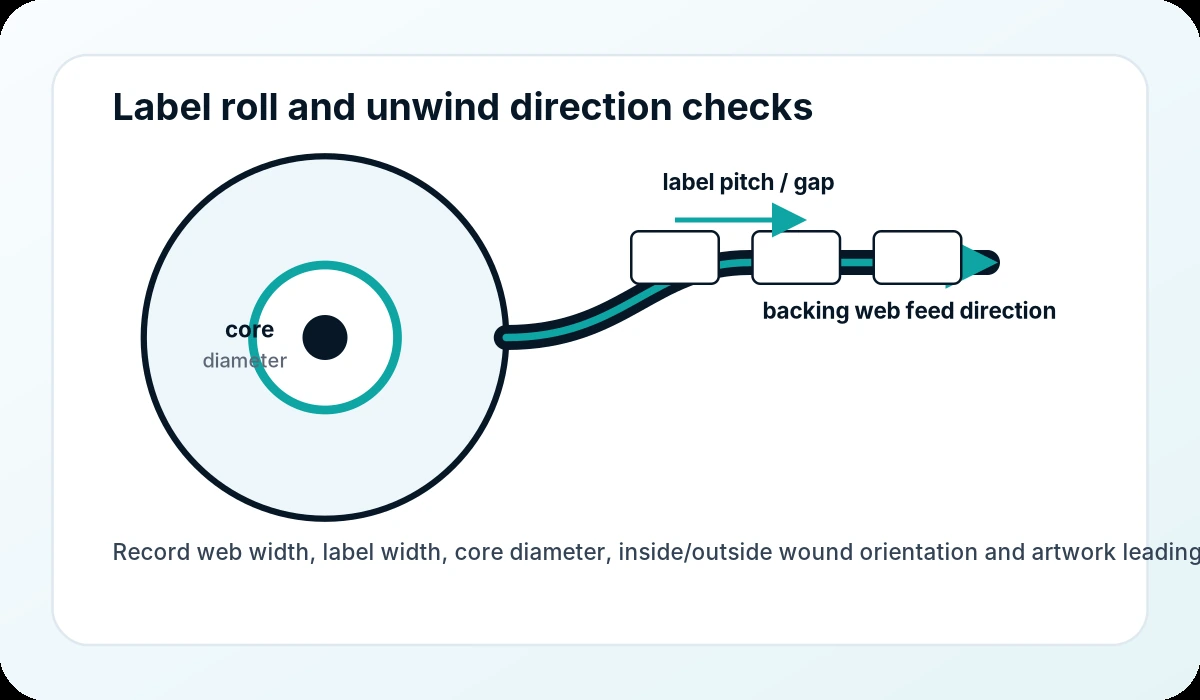
Label roll and leading-edge specification diagram

Illustration from the Lancing website. The actual bottle, finished label construction and approved machine configuration determine suitability.

Application guidance from Lancing. This page distinguishes planning checks from a verified machine specification; results must be confirmed against representative samples.